Senior Leaders
Senior leadership is tested where judgement, culture, people and performance meet
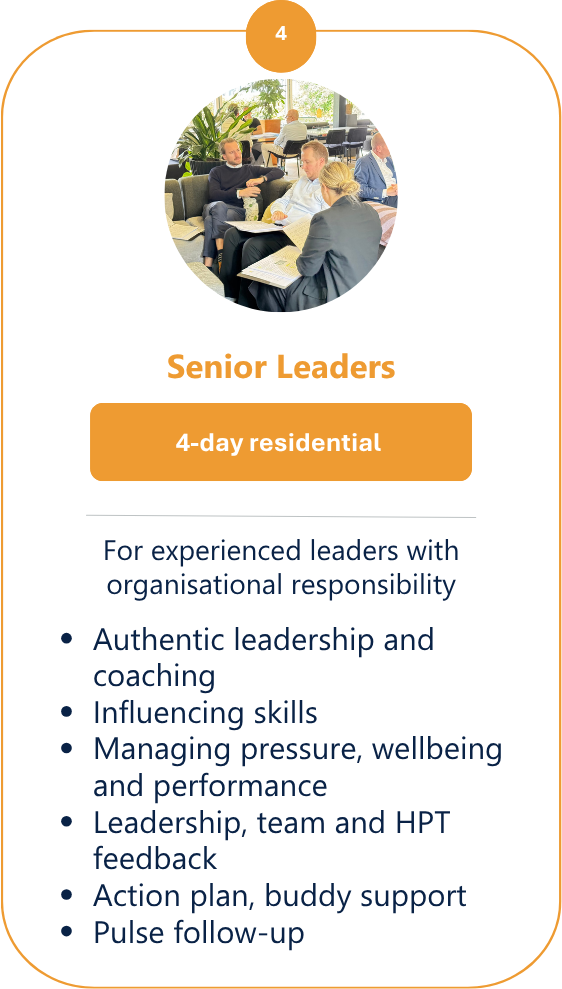
The TLS Senior Leaders programme is a four-day residential programme
for experienced leaders carrying significant organisational responsibility.
At this level, decisions affect more than an immediate team.
They influence direction, culture, capability and the conditions in which other people are expected to perform.
The programme gives senior leaders sustained time to examine those responsibilities away from normal workplace interruptions.
It can be attended directly by suitably experienced senior leaders;
attendance at earlier TLS Leadership Pathway programmes is not required.
A demanding participant experience
Senior leaders work on live organisational issues, interpret several sources of feedback,
challenge one another's assumptions and test different responses to complex situations.
The programme combines facilitated discussion, practical exercises, peer challenge, reflection and action planning.
Experience is respected, but it is also examined.
Three parts of the programme make that application particularly visible.
An authentic leadership exercise asks participants to examine the experiences, values and motivations that shape how they lead.
A DISC-centred team case study is then considered alongside High Performing Team results,
leading into a practical discussion about what the leader could do next.
Participants also complete a live coaching exercise using two different team members.
They consider how their approach needs to change for each person and build a coaching framework they can take back to the workplace.
Later, the influencing and consensus work is applied to a current leadership situation.
Participants identify who they need to influence, the outcome they are seeking and how they will approach it after the programme.
Several sources of feedback
Senior leaders work with more than one view of their leadership.
- Leadership 360 feedback shows how the individual’s leadership is experienced by others.
- Team feedback examines how effectively the leader is working with and through the team.
- High-performing team feedback looks more broadly at the conditions supporting team performance.
Taken together, the results can reveal issues that one measure alone would miss.
Strong individual feedback does not always mean the wider leadership environment is working well.
Team challenge, workload concentration and sustained pressure can show up elsewhere in the data.
Wellbeing and performance
The Good Day at Work Wellbeing System is included within the Senior Leaders programme.
The assessment gives leaders evidence about workplace pressure, psychological wellbeing, resilience, engagement and the conditions influencing people’s experience of work.
Where appropriate, aggregated data can also be used to examine patterns across a group.
That evidence helps leaders decide where attention is needed.
A wellbeing concern may be widespread, or the data may point to a particular part of the working environment.
Participants also consider how pressure affects their own judgement and how to recognise when someone
in their team may be struggling, with the emphasis on practical leadership responses.
Leadership Judgement
Senior leadership regularly involves choices where there is no clean answer.
Participants work with current organisational issues and consider the consequences of different courses of action.
- What needs attention now?
- Where should another leader be allowed to lead?
- What can the organisation realistically sustain?
- What message will a decision send beyond the immediate issue?
Influence and consensus form part of this work.
Senior leaders often need commitment from people they cannot simply direct,
and the programme gives them a structured way to think through how that influence will be built.
Experience matters at this level. So does the ability to question established assumptions.
From the residential into a 12-month journey
Each participant develops actions connected with current organisational responsibilities.
The programme then continues through application, coaching and review.
- manager or sponsor contact before and after the programme
- access to the Personal Learning Cloud and post-programme resources
- buddy or peer support across the development journey
- follow-up prompts that bring attention back to agreed actions
- 12 months of access to TLS leadership facilitators for coaching connected with the action plan
- a six-month Pulse follow-up where included in the agreed programme
- group roll-up reporting where an organisation wants an aggregated view across the cohort
- a 12-month review of progress, priorities and next development steps
